

More Psychological Strategies in Pricing
Human psychology plays a big role in how people perceive prices and pricing has a big impact in how buying decisions are made. For instance, pricing influences the perception of value. People often associate higher prices with higher quality, even if the product or service is no different from a lower-priced option. This is known as the “halo effect.” By setting a higher price, businesses can create the perception of value, even if the product or service is not actually worth that much. Also, pricing affects decision-making. When people are faced with a difficult decision, they might use price to make the decision easier. For example, if deciding between two products that are nearly identical, they might choose the one that’s priced lower to justify choosing one over the other… or the one that’s priced higher to explain that the choice was based on quality. In effect, pricing often serves as a shortcut for making decisions, especially when it is unclear which option is best. And, pricing can evoke emotions. Prices can trigger emotions like fear, greed, and scarcity. For example, a sale price can create a sense of urgency, which can lead to impulse buying. Similarly, a high price can create a sense of exclusivity, which can make a product more desirable.
By understanding how pricing impacts emotions and perceptions, businesses can use them to influence consumer behavior and set prices that are more likely to drive sales. There are a multitude of pricing strategies that are known to affect buying decisions. Some may seem illogical, random or even odd, but they work. And, even when consumers are aware of these strategies, they still work. Here are a few.
1. Price shelfs. A price shelf is when products or services are priced at certain price points considered to be psychologically appealing to consumers. For example, a product might be priced $99.97 rather than $100 because the former price is seen as being more affordable and attractive, even if the price difference is just three cents. That’s because a triple digit price can cause a product to fall off the price shelf.
There are a few reasons why price shelfs are effective. First, people tend to round prices up or down when they make purchasing decisions. This means that a product priced at $19.95 is likely to be seen as being closer to $10 than $20, which can make it more appealing to consumers even if that is illogical. Second, price shelfs can create a sense of urgency in consumers. When people see a product priced at “on sale for $19.95”, they may think that this is a good deal and that the price is likely to go up soon. This can lead them to buy the product sooner rather than later.
Amazon often prices its products at $19.99, $29.99, or $39.99. These price points are ‘price sweet spots’, and have been shown to increase sales. Walmart also uses price shelfs all the time. Many of its products are priced at $4.99, $9.99, or $14.99. These price points are easy for consumers to remember and make the products seem more affordable. And Apple — known for its high-end products — often prices its products at price points that are “premium.” For example, the iPhone 13 Pro Max is priced at $1,099. This price point is believed to appeal to consumers who are looking for a high-quality product. Consumers will mentally round that price down to $1,000.
Price shelfs can be an effective way to increase sales and boost profits. However, it is important to use them carefully. If the price shelf is too high, it can turn consumers off. And, if the price shelf is too low, it may not generate enough revenue. It’s also important to consider the target market when using price shelfs. Some price points may be more appealing to certain demographics than others. For example, price shelfs considered to be “premium” may be more appealing to consumers who are looking for high-quality products.
2. Price anchoring. Price anchoring is a psychological pricing strategy that involves setting a high anchor price before revealing the actual price. This makes the actual price seem more attractive by comparison. For example, a store might first show a $200 price tag for product, and then reveal that the actual price is $119. This makes the $100 price seem like a very good deal, even though it’s the price the product would have been priced at even if the anchor price had not been used.
For example, Best Buy might show a 65-inch TV priced at $1,000. If a customer is unsure whether that is a good price, so he uses his phone to shop around. He might find two similar TVs at other stores for $1,199 and $1,249. Now, the $1,000 TV seems like a much better deal, even though the price did not change from before he started comparison shopping. The price anchoring simply increased its perceived value.
Price anchoring is a powerful pricing strategy that influences buyer behavior even if the buyers are knowledgeable and savvy. By setting high anchor prices for related products, a business can make a particular product seem more attractive by comparison. This can lead to increased sales and profits. Anchoring bias was first identified by Daniel Kahneman and Amos Tversky in their article Judgment Under Uncertainty: Heuristics and Biases, which appeared in the journal Science in 1974. They claimed people make estimates of value by starting from an initial value that is adjusted to yield the final answer. Of course, this is a reasonable way for estimations to be made but their experiments found that people often start by anchoring to the wrong values, failing to account for differences between their anchor number and their estimate. Researchers have found repeatedly that “different starting points yield different estimates, which are biased toward the initial values.” In other words, people “anchor” to a value in their experience and rely too heavily on this in their estimation of a new value. This happens even in major purchases like real estate.
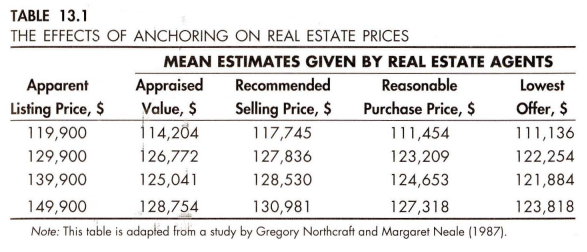
In one famous series of experiments in 1987, Gregory Northcraft and Margaret Neale at the University of Arizona showed a marked anchoring bias in valuation of real estate. In one of the studies, dozens of real estate agents were given an opportunity to tour one of two houses for sale in Tucson, Arizona-one that had been appraised at $74,900, or another that had been appraised at $135,000. During these visits, the agents were given a 10-page packet that included all the information normally used to determine the value of a residential property (except the official appraisal): the standard Multiple Listing Service (MLS) summary sheet for the property, MLS listings for other properties currently being sold in the neighborhood, information about nearby properties that had been recently sold, and so forth. All agents who inspected a given property received the same packet of information, with one exception: For some agents, the price of the home was listed at 11%-12% below the true appraised value; for others it was 4% below value; for others it was 4% above the appraised value; and for still others it was 11%-12% above value. Northcraft and Neale wanted to see whether these differences in apparent listing prices would lead to differences in later evaluations of the property.
The agents were given twenty minutes to walk through and around the property, after which time they provided their best estimate of (1) the appraised value of the property, (2) an appropriate advertised selling price, (3) a reasonable price to pay for the house, and (4) the lowest offer they would accept for the house if they were the seller. The table below summarizes these four estimates for agents who evaluated the $135,000 property (the $74,900 property produced similar results). The agents consistently saw the listing price as too high (regardless of what the listing price was), and all four estimates showed significant evidence of anchoring. Interestingly, however, when asked what their top three considerations were in making these judgments, only 1 agent in 10 mentioned the listing price.
These results were important for several reasons. First, they demonstrated the power of anchoring in a real-world setting. By changing only one piece of information (listing price) in a 10-page packet of materials, Northcraft and Neale were able to shift real estate appraisals by more than $10,000. Second, the results show that even experts are not immune to the effects of anchoring. Most of the agents had sold real estate for several years, yet this expertise did not prevent their judgments from being anchored. Finally, very few agents identified the listing price as an important consideration in their deliberations, although some agents may have been reluctant to admit relying on pricing information. (The researchers carried out other identical experiments on a group of students and got very similar results.)
Here are some considerations when using price anchoring:
- The strength of the anchor will determine how much it influences consumer expectations. A stronger anchor will have a greater impact on consumer behavior.
- The proximity of the anchor to the product or service being sold also affects its influence. An anchor that is closer to the product being sold will have a greater impact on consumer behavior.
- The context in which the anchor is presented will also affect its influence. For example, an anchor that is presented in a credible manner will have a greater impact on consumer behavior.
3. Color pricing. This is the practice of using certain colors to influence the perceived value of a product. For example, red is often associated with excitement and energy, so it might be used to price products that are seen as being high-end or luxurious. According to psychological studies, men are more likely to buy a product if the product pricing is displayed in red. This is because red is associated with power, strength, and danger, which is believed to make men feel more confident and decisive when making purchasing decisions.
Also, red is an attention-grabbing color, which helps draw men’s attention to products that are priced in red. This can be especially helpful for businesses selling products to men who are not actively shopping. This is just men; not women. Of course, not all men are equally influenced by the color red and some are more sensitive to the color than others. And the effect of the color red may vary depending on the type of product that is being sold. For example, the color red may be more effective for selling products that are associated with danger or excitement, such as products for cars or sports.
That said, there can be too much of a good thing. Red should be used sparingly when creating pricing displays and marketing materials. Too much red can be overwhelming and can actually have the opposite effect. Also, red should be paired with other colors, such as black, white, or gray, can help to soften the effect and make it more appealing to men. And, it should be used in specific areas such as in the call-to-action button on a website or for the headings in a catalog. It can also be used to create a sense of urgency, such as highlighting a sale or a limited-time offer.
The bottom line is that pricing is not a straightforward process but has a huge impact on the actual bottom line. It not only involves the cost to produce and sell the product or service, but also the value it has for the consumer. Understanding all the strategies that affect pricing and how pricing affects buying is key in order to set the optimal price for any product or service.
Quote of the Week
“Pricing is the exchange rate you put on all the tangible and intangible aspects of your business. Value for cash.” Patrick Campbell
© 2023, Keren Peters-Atkinson. All rights reserved.